About the contest
A national platform for budding microbiologists
An innovative series of competitions for UG and PG life-science students — built to spark a competitive scientific temperament and a deeper love for the world of microbes.
Our mission
What MicrobiOlympiad sets out to do
An innovative series of competitions for UG and PG life-science students — built to spark a competitive scientific temperament and a deeper love for the world of microbes.
Our objectives
- Provide a scientific platform for a national-level competition, fostering a scientific and competitive temperament.
- Assess the logical reasoning and analytical skills of life-science students.
- Enhance reading skills and comprehension through innovative activities.
- Acquaint students with R programming for data analysis and computational tasks.
- Promote social responsibility and health & hygiene awareness through street plays.
- Expose students to novel scientific avenues via eminent national and international scientists.
- Inspire students through the research and career journeys of successful life-science personalities.
History & origin
Conducted every year since 2001
In remembrance of two giants of microbiology — Louis Pasteur and Robert Koch — and founded by Prof. Ulhas Patil.
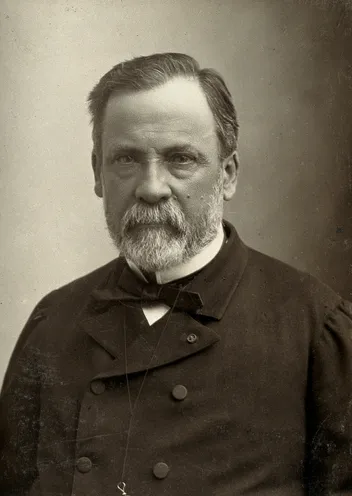
Historical photograph, public domain.
Louis Pasteur was born on 27 December 1822 in Dole, in the Jura region of France, and trained as a chemist. His early research on the asymmetry of tartaric-acid crystals founded the science of molecular chirality — but it was his turn to the living world of microbes that reshaped medicine.
Studying fermentation, Pasteur showed that living micro-organisms, not spontaneous chemistry, turned sugar to alcohol and spoiled wine, beer and milk. His elegant swan-neck-flask experiments disproved the doctrine of spontaneous generation and gave the germ theory of disease its experimental footing. To protect perishable liquids he devised gentle heating — the process the world now calls pasteurization.
Extending Edward Jenner’s idea of inoculation, Pasteur developed vaccines from weakened (attenuated) microbes — for fowl cholera, then anthrax in a famous 1881 public trial at Pouilly-le-Fort, and in 1885 a rabies vaccine that saved the young Joseph Meister. In 1888 the Institut Pasteur opened in Paris as a centre for research, teaching and treatment. He died on 28 September 1895, honoured as one of the founders of modern microbiology and immunology.
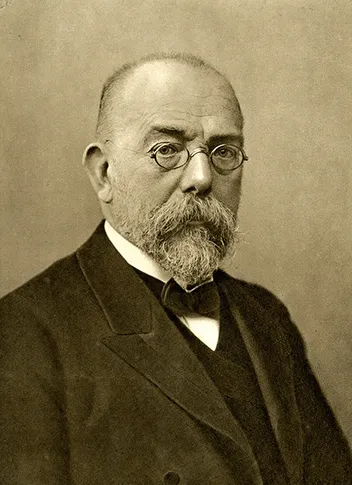
Historical photograph, public domain (Reynolds-Finley Historical Library, UAB).
Robert Koch was born on 11 December 1843 in Clausthal, in the Harz mountains of Germany, and worked as a country physician before his laboratory discoveries made him a founder of medical bacteriology. Where Pasteur illuminated how microbes behave, Koch proved which specific microbe caused which specific disease.
Working at first with a home microscope, Koch traced anthrax to the bacterium Bacillus anthracis in 1876 and worked out its spore-forming life cycle. He identified the tubercle bacillus (Mycobacterium tuberculosis) in 1882 and the cholera vibrio in 1883–84. From this work he framed Koch’s postulates — the logical criteria still used to link a micro-organism to a disease.
Koch was also a superb technician: he and his colleagues pioneered pure-culture methods on solid media, bacterial staining and photomicrography — techniques (the agar plate, the Petri dish) that made modern microbiology a repeatable laboratory science. He was awarded the Nobel Prize in Physiology or Medicine in 1905 for his investigations of tuberculosis, and died on 27 May 1910 in Baden-Baden.
- 2001The contest begins
Founded by Prof. Ulhas Patil and dedicated to Louis Pasteur & Robert Koch, the MicrobioLogical Contest and MicrobiOlympiad are held for the first time.
- 202019th edition
The contest reaches its 19th edition, held in January 2020.
- 202422nd edition
3,719 participants compete across all competitions; the grand finale is held on 10 February 2024.
- 2024–2523rd edition
The national network grows beyond 100 colleges across India.
A quarter-century of microbiology
From a single contest in 2001 to a national network of 100+ colleges — the 25th MicrobiOlympiad marks twenty-five years of igniting scientific curiosity in life-science students across India.
Founded by Prof. Ulhas Patil and dedicated to Louis Pasteur & Robert Koch, MicrobiOlympiad has grown every year into the country’s foremost celebration of budding microbiologists.
- Years since 2001
- 25Years since 2001
- Partner colleges
- 100+Partner colleges
- Themed contests
- 10Themed contests
- Silver Jubilee finals
- Feb 2027Silver Jubilee finals
Organizers
The organizing team
Organized by the MicrobiOlympiad team in collaboration with DockGenix.